23.02.2026
International University Collaboration Implemented Unique AIoT Course
The University of Jyväskylä, together with three other international universities, has provided new course titled Developing the Artificial Intelligence of Things (DevAIoT). Thematically, the course covers the core content of artificial intelligence and the Internet of Things (IoT), responding to the development of AI technology and the evolving needs of working life.
The aim is to provide students with an in-depth understanding of how artificial intelligence can be used in various ways within IoT systems. The course includes both theoretical lectures and practicalassignments, focusing for example on programming constrained devices, implementing data analysis, and integrating different types of AI models into IoT devices and systems.
In addition to Assistant Professor Niko Mäkitalo from the University of Jyväskylä, the course was implemented in collaboration with Professor Petteri Nurmi and Dr. Agustin Zuniga from the University of Helsinki (coordinator), Professor Archan Misra from Singapore Management University, and Professor Santi Phithakkitnukoon from Chiang Mai University. The collaboration is part of an international project in which four universities have jointly developed teaching materials and organized joint teaching events and workshops in three different countries.
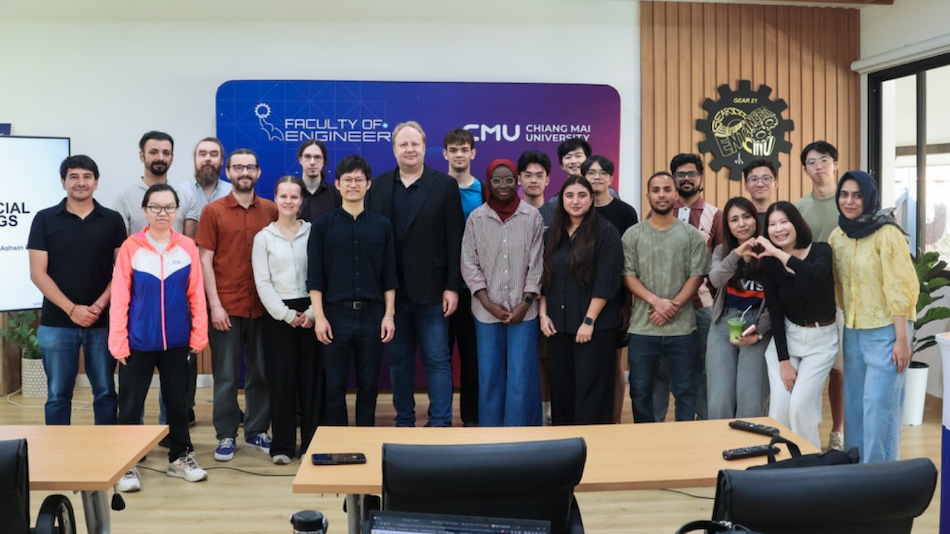
The project aimed to emphasize an international perspective for students as well, which made the first implementation of the course rather exceptional. At the beginning of the course, in November last year, students from Singapore and Thailand visited Finland for two weeks. Now, at the end of the course, January–February, Finnish students had the opportunity to visit both Singapore and Chiang Mai for one week each.
The collaboration and course format have provided students with a unique opportunity to work together in international student teams and to develop projects and various prototypes that utilize AI and IoT technologies to solve everyday challenges. The course has received plenty of positive feedback from the participants, particularly regarding the international approach and strong project-based focus. Students clearly enjoyed the course and got along excellently with one another.
The ultimate goal of the project is to offer the developed teaching materials as a so-called MOOC course, which students from different universities can complete independently online. Although online teaching has its advantages, it is of course unfortunate that students will not have the opportunity to travel to different parts of the world every year. However, perhaps a similar approach could be applied in the future to the development of other courses as well.