13.05.2026
Quality for distance learning
The "Solutions for Distance Learning" webinar generated widespread interest
The webinar brought together a large group of educational developers to discuss current challenges and solutions in distance learning. The event featured practical innovations designed to increase interactivity, implement virtual labs, and utilize learning analytics to support teaching.
The “Solutions for Distance Learning” webinar attracted significant interest from various levels of education, with over 100 participants registering for the event. The webinar was organized by the “Quality in Distance Learning” project, whose key findings were presented at the event.
– The interest in the webinar was a pleasant surprise for us. It shows that education is undergoing a certain kind of transformation and that people are looking for new solutions, says project manager Tuomo Härmänmaa.
The webinar presented solutions developed within the project to address key challenges in distance learning. Topics included increasing interaction in video-based instruction, remote laboratories, and the use of data and learning analytics to improve teaching. The event provided participants with concrete examples and practical ideas to support their own teaching practices.
From the Challenges of Distance Learning to New Solutions
The webinar was opened by Research Coordinator Mikko Myllymäki, who provided background on the project and its development. He emphasized that distance learning is not merely a technological solution, but also a pedagogical shift that places new demands on interaction and student guidance in particular.
Myllymäki highlighted two key challenges: changes in interaction and the implementation of learning by doing in a remote setting. At the same time, he emphasized the opportunity offered by digital learning environments to utilize data generated from learning to improve teaching.
Interactive lecture videos engage students
Härmänmaa and application designer Jenni Yrjänä presented an interactive exam tool developed as part of the project, which is directly linked to lecture videos. In this solution, students are presented with questions at predefined points while watching the video.
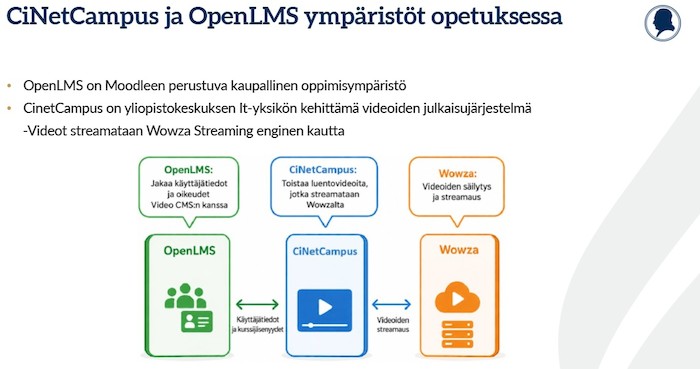
– The goal of the tool is to increase student engagement, support learning, and ensure that key concepts are understood. At the same time, it provides teachers with valuable insight into where students are struggling,” explains Yrjänä.
Based on feedback, the solution has been particularly successful in supporting concentration and helping students organize their studies. The interactive elements provide structure to the videos and help students assess their own skills.
Remote labs enable learning by doing
Project Researcher Sanna Laine gave a comprehensive presentation on IoT laboratory work conducted in remote environments. The course offerings cover a wide range of topics, in which students work either with physical devices or in simulation environments.
Examples presented included:
- microcontroller-based programming exercises
- measurements and analysis related to signal strength
- speech recognition solutions utilizing machine learning
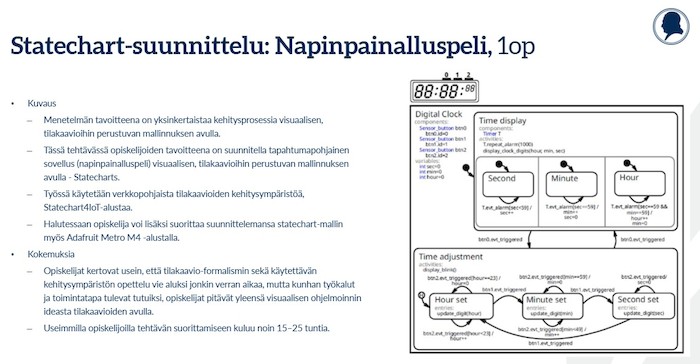
– The solutions combine hands-on practice with theoretical understanding. Laine points out that students can complete the assignments at their own pace, often in their own home environment.
Myllymäki also presented research findings comparing the use of physical devices and simulators. According to the results, simulations are well-suited to many teaching situations, even though physical devices are often perceived as more motivating and concrete.
Data and analytics supporting the development of teaching
At the end of the webinar, Laine presented the possibilities of learning analytics. The project has developed visualization solutions that can be used to analyze, for example:
- the use of lecture videos
- student progress
- course performance and graduation
Teachers can review data from their own courses and gain insights into, for example, how actively students are engaging with learning materials. Educational providers, in turn, gain an overall picture of the effectiveness of the program.
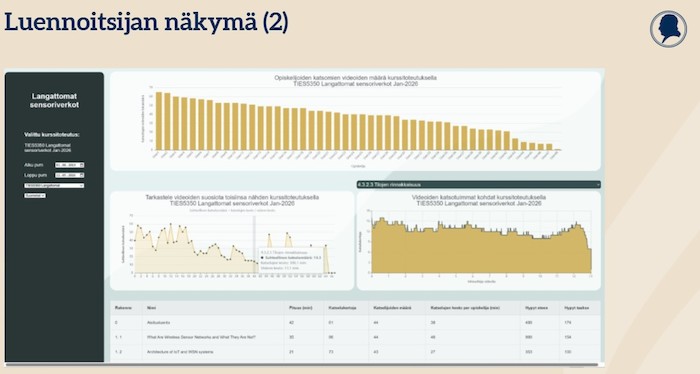
– The project has placed particular emphasis on data protection and ethical issues. The goal of learning analytics is not to profile students, but to support learning and improve teaching, Laine points out.
Practical solutions and inspiration for development work
The webinar emphasized that the solutions presented are not directly transferable to all environments, but were developed for a specific educational context. The primary goal was to provide ideas and inspiration for the development efforts of other organizations.
The event offered participants a comprehensive overview of the current state of distance learning and its future prospects. The discussions particularly highlighted the need to combine pedagogical thinking and technological solutions in a meaningful way.
The Quality in Distance Learning project will conclude in the fall of 2026, and the webinar serves as one of the project’s key events for presenting its results.
Extra information
Tuomo Härmänmaa, project managerJenni Yrjänä, application designer
Sanna Laine, project researcher
Mikko Myllymäki, research coordinator