27.05.2026
DustSense – Smart Dust Monitoring in Industrial Areas
Air Quality Directive Reforms Highlighted at the Helsinki Meeting
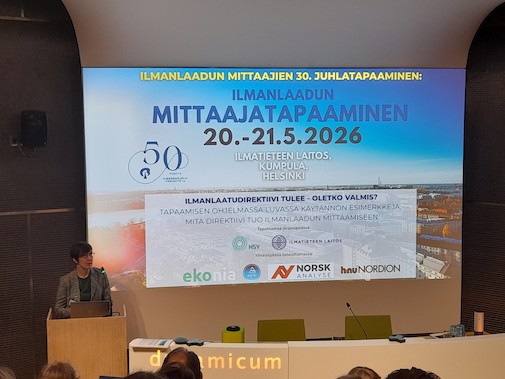
We participated in the air quality monitoring meeting held in Helsinki on 20–21 May 2026. This year’s meeting focused strongly on the Air Quality Directive (2881/2024), which will enter into force at the end of the year. The directive introduces some changes to the air quality monitoring network maintained by municipalities and the state, but above all it affects the limit values for air pollutants.
The environmental quality standards for air quality will become stricter starting in 2030. For example, the limit value for inhalable particles (PM10) will be reduced to 45 µg/m³ (daily average), and the number of exceedance days will be limited to a maximum of 18 per year. Currently, the limit value is 50 µg/m³, with up to 35 exceedance days allowed per year. Existing target values for substances such as nickel, arsenic and cadmium will become binding limit values from 2030 onwards.
The directive also includes a requirement to prepare a report if the new limit values, which will apply from 2030, are exceeded during the period 2026–2029. The report must demonstrate how the limit values will be achieved.
Stricter limit values will also affect the air quality index, which is used to communicate air quality conditions to the public. The index takes several air quality factors into account, and as the limit values decrease, it may indicate poorer air quality more readily than before, even if pollutant levels remain unchanged. A new category will also be added to the index: a fair category will be introduced after the “good” level. The directive places particular emphasis on sensitive population groups, for whom communication must be specifically targeted.
The changes introduced by the directive will not directly affect the activities of the DustSense project. However, the project supports future developments by increasing awareness of measurements carried out with small dust sensors and by promoting the development of dense monitoring networks.
News related cases
Pölyn monitorointiExtra information
Timo Hongell, project managerMira Hästbacka, project coordinator