18.06.2026
DustSense – Smart Dust Monitoring in Industrial Areas
A mobile dust sensor maps the environment in real time
At the University Consortium of Kokkola, new solutions for environmental measurement are continuously being developed in IoT projects. In the recent MOPSI project, a student team implemented a mobile dust sensor system that enables real-time monitoring of particulate concentrations from a moving measurement device.
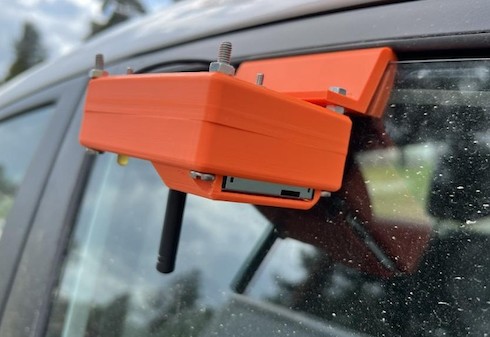
The goal of the project was to develop a cost-effective and easily portable prototype that collects data especially in industrial environments. At the core of the solution is a measurement device mounted on a vehicle, which measures airborne PM10 particles and combines the measurements with location data.
Mobile measurement for industrial areas
Traditionally, dust is measured using fixed monitoring stations, but in the MOPSI project the aim was to bring measurement closer to real-world conditions. The device can be attached to a vehicle, allowing it to collect continuous measurement data along the entire route traveled.
The device measures particle concentrations approximately once per second and creates a measurement point every hundred meters. The data is supplemented with humidity, location, and timestamp information, enabling more detailed analysis of air quality across different areas.
Visual interface supports analysis
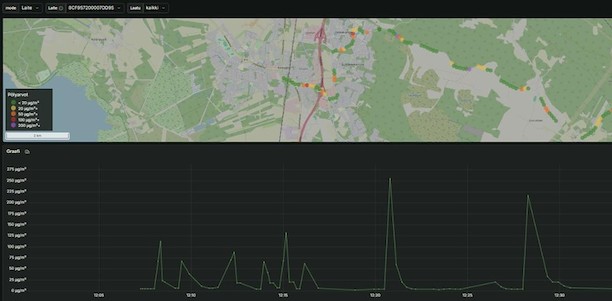
A dashboard developed in the project presents the measurement data on a map using color codes, making variations in air quality easy to interpret.
The visualization also takes measurement reliability into account: high humidity can distort results, so unreliable measurements can be filtered out during analysis.
Technical challenges as part of development
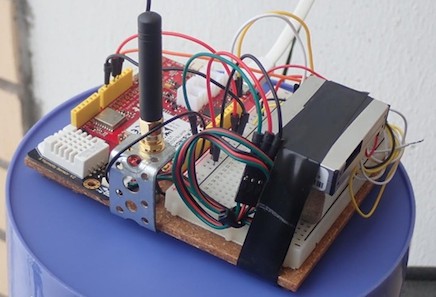
During the project, several technical challenges were encountered, particularly related to GPS positioning and LoRa data transmission. Connections could be slow or interrupted, which affected the density of measurement points.
In addition, data transmission proved to be a critical factor in the system, as measurements could not be taken during transmission, and it could also interfere with the operation of the sensor.
Despite these challenges, the project resulted in a functional end-to-end solution, from the measurement device to cloud-based visualization.
Next step: pilot in the KIP area
The development of mobile dust measurement will not remain at the project level. The next step is to test similar measurement solutions in practice within the DustSense project at the Kokkola Industrial Park (KIP).
In this project, a dedicated measurement system will be built, but the experiences from the MOPSI project provide valuable groundwork, especially for developing measurement logic, data transmission, and usability.
News related cases
Pölyämiseen liittyvät selvityksetPölyn monitorointi
Extra information
Timo Hongell, project managerMira Hästbacka, project coordinator