10.06.2026
Smart and sustainable living
Data Flows in Smart Buildings – What Happens Behind the Scenes?
A smart building isn’t just about devices and their associated apps; above all, it involves a vast amount of data that flows from one part of the system to another and is processed along the way.
The architecture shown in the figure illustrates how complex this network of data flows is in the case of the concept house built as part of the Smart and Sustainable Living project.
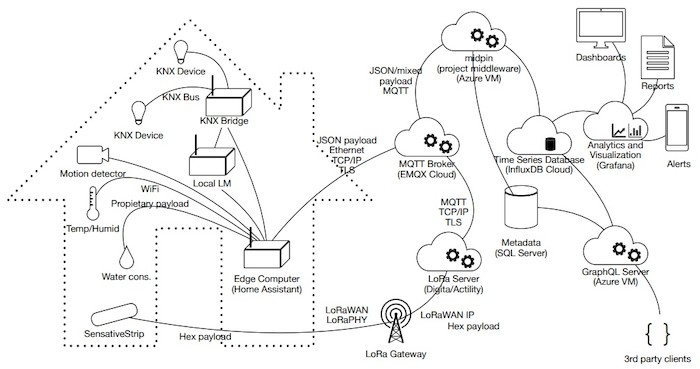
Data is generated by physical devices installed in the building, such as temperature, humidity, and motion sensors, as well as water consumption meters. These devices use various data transmission technologies to communicate with other devices, such as the KNX bus, Wi-Fi, and the LoRaWAN network. The data can also be quite diverse in the early stages: for example, many manufacturers use their own formats for presenting and transmitting data.
In the next step, the data is transmitted through gateways and servers so that it can be used to generate visualizations or analyses related to the building and its occupants. Open and standards-compliant technologies, such as MQTT broker services and the GraphQL interface, ensure that data can be reliably collected, combined, and shared between different systems. The IoT solutions in the concept house are based on several different technologies, so this phase is crucial.
Once the data has been transferred to the cloud service, it is stored and enriched with the necessary contextual information. The time-series database is responsible for storing the measurement data, while metadata (e.g., device location and type) is managed in separate databases. On top of this is an analytics and visualization layer, where the data is transformed into information that users can understand: views, reports, and alerts.
The system is managed by middleware, which controls data flows by, for example, standardizing their formats and thereby integrating different systems. The GraphQL interface also allows third-party applications to be integrated.
The true value of a smart building—or any IoT data, for that matter—is realized only through data processing. Simply collecting data is not enough; what is needed is a functional architecture that ensures data transfer, compatibility, and meaningful utilization.
Extra information
Lasse Harjumaa, senior lecturerPetri Jyrkkä, project manager